Saturday, January 25, 2014

Steering, skidding and avoiding spin-out

Richard and I talked about the possibility of having the handling of the dots feel more 'car' like, and wondered whether that would make things more fun. More skidding and steering.

I've been fiddling with Unity's wheel colliders to see how feasible this would be. In case you didn't come across these before, they're a special kind of physics-enabled object that have independent friction curves for forward (rolling) and lateral (skidding) movement. Wheel colliders also have steeringAngle and motorTorque properties to quickly get them behaving as you'd want when building some kind of vehicle.

I've based my 'dot' controller here on a stripped-down version of the futuristic sports car controller in Unity's new Sample Assets package.

The first problem I noticed is that it was very easy to get into an uncontrolled spin, which wasn't much fun. There ought to be plenty of skidding round corners, but very little spinning.

While googling spin-out I found this wikipedia article

in a car with a short wheelbase, the short lever arm from the CM to the rear wheel will result in a greater lateral force on the rear tire which means greater acceleration and less time for the driver to adjust and prevent a spin out or worse.

Sure enough lengthening the wheelbase helped a great deal.

Monday, September 9, 2013

A MAZE. Johannesburg

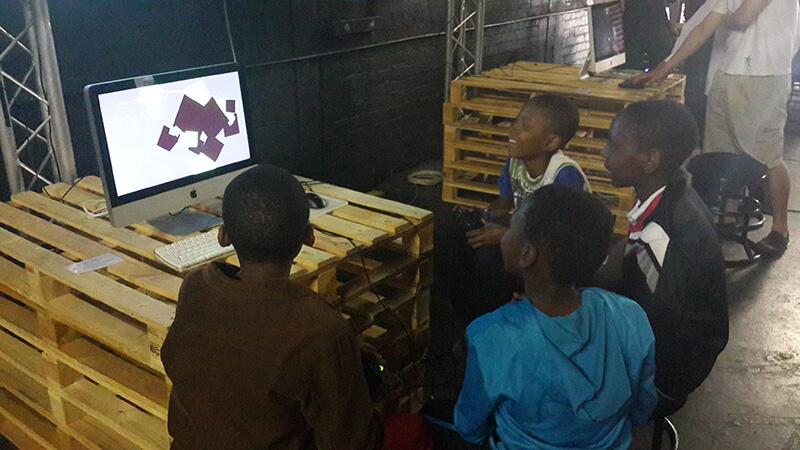
It's such a nice feeling when the young folk appreciate your game. Here's Chalo Chalo being played during A MAZE. Johannesburg. via Peter Gardener on Twitter.

Saturday, July 20, 2013

Wednesday, April 24, 2013

Chalo Chalo at A MAZE

Chalo Chalo will be playable in Berlin on April 25th 2013 (tomorrow) as part of Local Multiplayer Picnic at the A MAZE indie connect festival.

The site describes the game thus:

CHALO CHALO by Richard Boeser and Tomasz Kaye. If you hear people shouting while seeing dots move slowly, they are probably playing Chalo Chalo, one of the most nail-bitingly intense racing games. Random tracks and upgrades are mixed together with extremely tight, minimalist design to make sure every single race turns out completely different.

Sunday, November 25, 2012

Experiments with isocron maps

We're interested in ways of mapping race information in the post-race display. One way of doing that it to use isocron maps. The idea is that a curve is drawn that connects the positions that all players were in at a given moment. Using a series of these lines, you can get a sense of how the relative distances between players changed over the course of the race. Right now there are loops appearing, and other weird things that aren't quite right. Looks pretty though.

Friday, November 9, 2012

Frogs and lotuses

The latest build of Chalo Chalo will be playable at Copenhagen's first Local Multiplayer Picnic on November the 18th, and at the Versus event in WORM, Rotterdam on the 24th of November.

To business: Between races, Chalo Chalo players get to see their scores. Up until now, the scores have been indicated by solid blocks of colour. Something like this:


The trouble is that players can have negative scores (losing a race loses you one point), but the scheme above doesn't display any score below zero. One solution we've been talking about is to use a special symbol to indicate negative points. I've been fiddling with this approach. Visually, as soon as a symbol was introduced to indicate negative points a couple more problems became apparent: the positive point indicators were less interesting to look at than the negative indicators, and the discrepancy between abstract and representative indicators was annoying. Here's the work in progress as it stands now, using icons for both negative and positive icons. A lotus flower for positive, the frog for negative.
I'm not happy with it yet. I don't like the tension between the icons and the rectangles they inhabit. The grid of rectangles, on its own, divides up and 'activates' the screen space in a pleasing way, while the irregular outlines of the icons work to deny that grid. The two tendencies are battling with each other too much at the moment. Also, the dark, but coloured, backgrounds of the 'inhabited' rectangles are too similar in tone to the uninhabited squares, making the image feel fiddly.
That's a bit better.

Saturday, October 20, 2012

Stupor becomes Stupify

Here's my slightly wordy in-game description of one of Chalo Chalo's power-ups:

On pressing an action button the nearest competitor is targeted. On release their ability to change speed or direction is temporarily removed.
Single use. Hold button to target nearest player, release to activate.

This power-up began life when Richard entered the idea into our mighty power-up-ideas-spreadsheet under the name "Steer Stealer (Tomasz please think of a decent name for this one)".

I did my best, and renamed it Stupor. Since it causes another player to fall into a 'stupor'. It turns out it could be better still.

A seemingly relevant detour: My naming strategy for power-ups has been to choose terms that are short, somehow descriptive of their function, and obscure. In that order of priority. Certainly among my favourite names at the moment is Richard's Remi: the player travels faster in proportion to haw far away he/she is from the other players. The name is a reference to the lonely protagonist from the 1878 novel Sans Famille (Alleen op de wereld in Dutch). In second place for me is Safa, an as-yet unimplemented power-up that, upon activation, causes the goal to slowly move towards the empowered player. Safa is a reference to the mountain that Mohammed commanded to come to him. According to the legend, the mountain didn't come to Mohammed in the end. In Chalo Chalo the goal will be more obliging.

Anyway, Stupor. It turns out it's not ideal. We noticed that everyone ends up calling it Stupify. It makes sense: Stupify is what you do, from the perspective of the user of the power-up, you stupify another player. You don't enter a stupor yourself. And this feels a much more natural way of referring to it.

This is one of the many cases that the iterative approach we've been taking to developing the game has been valuable. These days most of the development decisions happen after playtesting. Recently that's been at the Local Multiplayer Game Picnic events, and at the Indigo 2012 game event.

I think of renaming this power-up as analogous to paving a path that people have already trodden through the grass. I don't think there's any shame in admitting that spontaneous order is smarter than I am. In fact, whether appropriate or not, I feel almost proud of that!